- Free Consultation: (631) 352-0050 Tap Here to Call Us









Firm Wins Appeal of Housing Discrimination Case with a Unanimous Decision


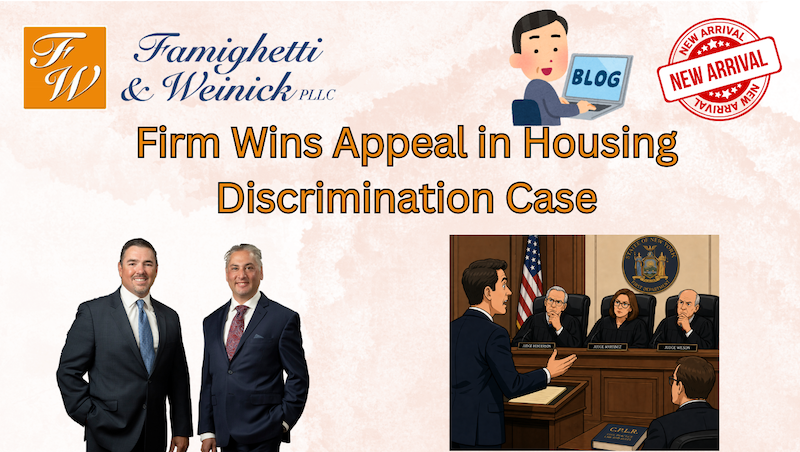
Famighetti & Weinick PLLC has won an appeal of a housing discrimination case. The decision was unanimous from the panel of appellate judges. Today’s blog discusses the case. The facts below are taken from the publicly available documents filed in the case of Forrester v. Tichenor, et. al.
F&W filed a discrimination lawsuit on behalf of its client. The lawsuit alleged, in brief, that the client tried to purchase a co-op unit to use for her medical office. The client is a black female nurse practitioner who operates a medical office providing skin care and beauty restoration services.
In the summer of 2023, the client was searching for a new office for her practice. She found a co-op unit on Park Avenue in Manhattan which suited her needs. The unit was marketed as being in one of Manhattan’s preeminent coop buildings. The unit had been listed for sale for three years and was being used as a medical office. The client made an offer and was about to finalize the contract, when another buyer suddenly surfaced. The seller sold the unit to this other buyer. As alleged in the lawsuit, the other buyer was a white male who was also a member of the building’s board of directors and owned another unit in the same building already. Based on these facts, the client alleged that this sale demonstrated race and gender discrimination.
On behalf of the client, F&W filed a lawsuit in New York County Supreme Court alleging housing discrimination based on race and gender. The lawsuit named the individual seller, the co-op corporation, and the co-op’s managing agent. The basis of liability against the co-op and managing agent was that the buyer-interloper, was a board member, so his actions can be imputed to the corporations.
The co-op and managing agent moved to dismiss the claims against them arguing that the complaint did not allege their liability with the specificity required by New York’s Civil Practice Law and Rules. F&W opposed the motion, but ultimately the court granted the motion and dismissed the two corporations from the case. The claim against the individual seller proceeded.
F&W appealed. F&W argued primarily that the corporations were demanding the court impose a heightened standard of pleading than is required by the law. Using the proper standard, “notice pleading,” F&W argued that the facts which were pled allowed inferences to be drawn showing that the corporations were involved in the discrimination. Further, F&W argued that co-op board members are agents of the board, so their actions can be imputed to the board.
On April 9, 2026, F&W partner, Matt Weinick, attended oral arguments for the appeal at the First Department. Facing what is commonly called a “hot bench,” or a panel of judges who actively question the lawyers arguing before them, Weinick fielded a flurry of questions which immediately signaled that the judges understood F&W’s arguments and were unsure about whether the lower court’s decision was the right decision.
Sure enough, on May 5, 2026, the Appellate Division, First Amendment issued its order unanimously reversing the lower court’s decision, reinstating the claims against the corporations, and awarding costs.
The Appellate Division first noted that the law imposes only a “lenient” notice pleading standard. At such an early stage of the case, the appellate court determined that the lower court should not have dismissed the case.
Notably, the First Department observed that the complaint’s facts showed that discrimination based on race and/or gender could have influenced the seller’s decision to not sell to the client. The court was swayed by facts including that the seller chose not to sell to the black female buyer who was qualified to purchase the unit, instead choosing to sell to a white male applicant who was not a medical professional and thus could not use the unit for its intended purpose.
Further, the Appellate Division agreed that that complaint showed that the corporations could be liable for the discrimination through the acts of the white male buyer. The co-op could be liable because the buyer was a board member, so he is an agent of the board. The managing agent could be liable because it was involved with the purchase.
The decision is a resounding win for F&W’s client. The case will be sent back to the Supreme Court so the claims against the corporations can be litigated.
If you have questions about discrimination, housing discrimination, or appeals, contact a New York discrimination lawyer at http://linycemploymentlaw.com. Our phone number is (631) 352-0050.
The full First Department decision is available on the Court’s website.