- Free Consultation: (631) 352-0050 Tap Here to Call Us










Second Circuit Revives Long Island Union Employee’s Disability Accommodation Claim


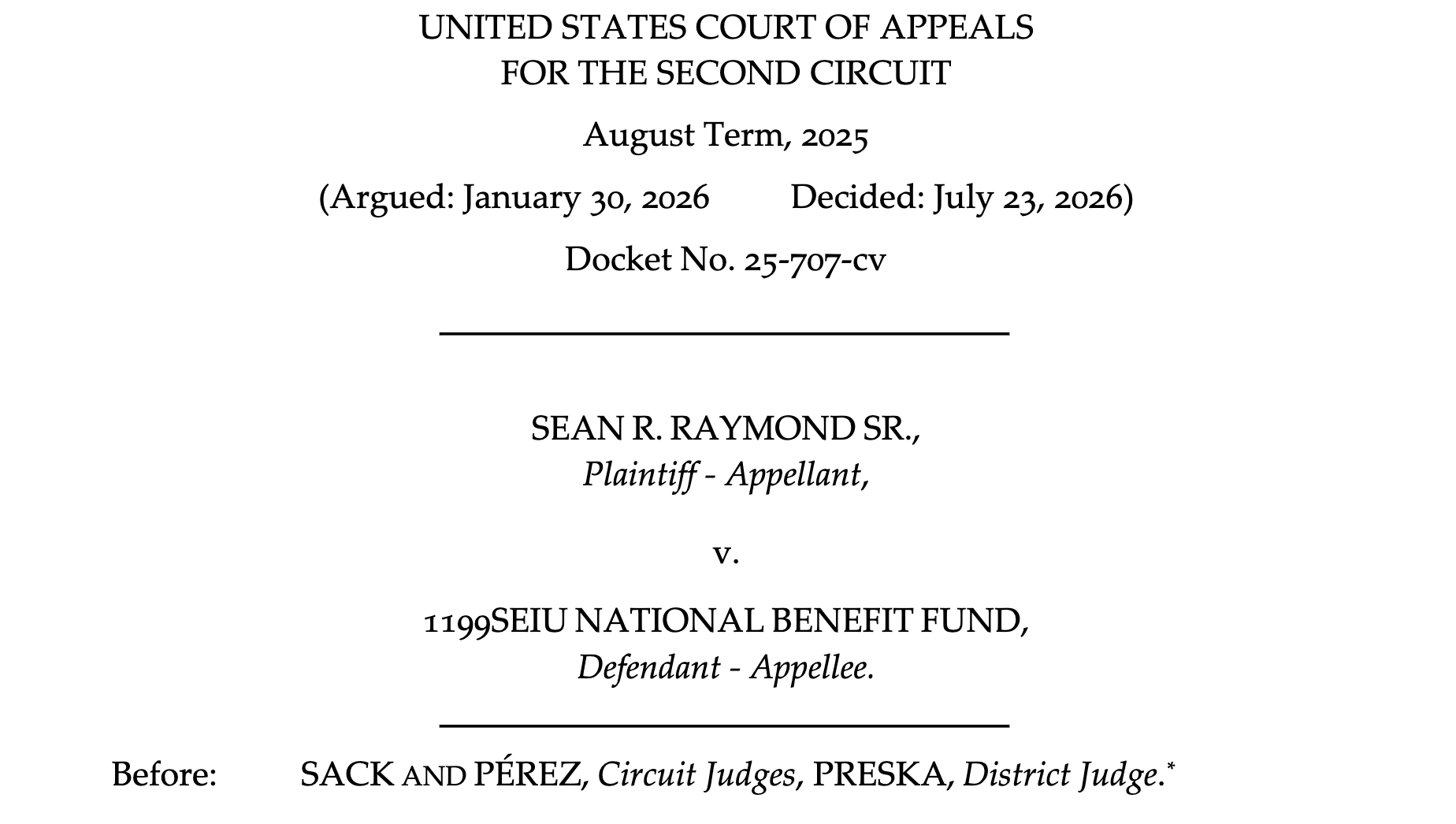
Employees with disabilities who feel their employer’s “accommodation” was little more than a token gesture just got a helpful reminder from the U.S. Court of Appeals for the Second Circuit: an accommodation isn’t reasonable simply because the employer did something. It has to actually work. That was the central holding in Raymond v. 1199SEIU National Benefit Fund, decided July 23, 2026, a case that offers important lessons for New York employees navigating the accommodation process under the Americans with Disabilities Act (ADA).
The Facts
Sean Raymond Sr. worked for the 1199SEIU National Benefit Fund for nearly 30 years, most recently as an Outreach Coordinator responsible for driving to healthcare facilities across Long Island. After developing a serious vein condition that required multiple hospitalizations, Raymond’s doctors progressively restricted his ability to sit or drive for extended periods — eventually limiting him to no more than thirty minutes of continuous driving.
When Raymond reported these restrictions, NBF’s response was to remove the four facilities located farthest from his home from his assigned territory. That still left him with numerous stops requiring drives well beyond thirty minutes. Raymond asked to be reassigned back to his previous, more compact territory, which required more frequent but shorter drives. NBF refused, and when Raymond was ultimately unable to secure a doctor’s note clearing him to work “without restrictions,” the Fund terminated his employment.
Raymond sued under the ADA, alleging both a failure to accommodate and disability discrimination. The district court granted summary judgment to NBF on the accommodation claim, reasoning that removing four stops was enough to show NBF had “responded” to Raymond’s needs. His discrimination claim went to trial, where a jury sided with NBF, and the district court later denied Raymond’s motion for a new trial.
The Second Circuit’s Ruling
On appeal, the Second Circuit vacated the summary judgment ruling and sent the accommodation claim back for further proceedings. The court’s reasoning is significant for employees and their advocates.
An accommodation must be effective, not just responsive. The panel held that the district court applied the wrong legal standard by treating any employer action addressing an employee’s request as automatically reasonable. Under established Second Circuit precedent, the touchstone of a reasonable accommodation is effectiveness — it must actually enable the employee to perform the essential functions of the job. Simply removing four stops while leaving nine or more locations still requiring drives longer than Raymond’s medical restrictions allowed raised a genuine factual question about whether NBF’s response actually solved the problem.
Requests for reassignment can be plausible accommodations even to a “filled” position. NBF argued that Raymond’s request to return to his old territory wasn’t a valid accommodation because that assignment wasn’t vacant. The Second Circuit pushed back, noting that a jury could view Raymond’s request as simply asking for a new assignment within the same job title, not a transfer to a different position. The court also observed that if an employer regularly shuffles employees between territories or assignments, a similar request from a disabled employee may be reasonable even without a technical vacancy — an important point for employees whose employers routinely rotate duties, territories, or shifts among staff.
Factual disputes about the severity of a disability belong to the jury. The court emphasized that whether a doctor’s note accurately reflects an employee’s limitations, and whether a given job assignment actually requires activity beyond those limitations, are quintessential jury questions that cannot be resolved by a judge on summary judgment.
A Mixed Result on the Discrimination Claim
Not everything in the decision favored Raymond. The Second Circuit dismissed his separate challenge to the denial of his motion for a new trial on the disability discrimination claim, holding — somewhat reluctantly — that under existing Second Circuit precedent, a district court’s denial of a Rule 59(a) motion on weight-of-the-evidence grounds simply isn’t reviewable on appeal. Notably, the panel went out of its way to flag that every other federal circuit allows this kind of review, suggesting this may be an area ripe for reconsideration by the full Second Circuit down the road.
What This Means for Employees
This decision reinforces a critical point for New York workers seeking workplace accommodations: employers cannot check the box by making a partial or symbolic change and calling it a day. If a modification doesn’t actually solve the problem — if an employee can still be assigned work well outside their medical restrictions — courts should not automatically treat that as satisfying the employer’s obligations under the ADA.
The ruling also confirms that employees are not necessarily limited to requesting brand-new, vacant positions. Depending on how an employer typically manages assignments, requesting reassignment within an existing role can itself be a legitimate accommodation request.
Talk to an Employment Lawyer
If your employer has offered an accommodation that doesn’t actually address your medical restrictions, or you’ve faced discipline or termination after requesting one, you may have rights under the ADA and New York law. The attorneys at Famighetti & Weinick PLLC represent employees throughout New York in disability discrimination and failure-to-accommodate cases. Contact us to discuss your situation. More information about the firm is available at http://linycemploymentlaw.com. The full Raymond decision is available at https://ww3.ca2.uscourts.gov/decisions/OPN/25-707_opn.pdf.
This post is for informational purposes only and does not constitute legal advice. Every case depends on its own facts.