- Free Consultation: (631) 352-0050 Tap Here to Call Us









Second Circuit Overhauls the Test for Religious Accommodation Claims: What Employers and Employees Need to Know About Bergin v. New York State Unified Court System


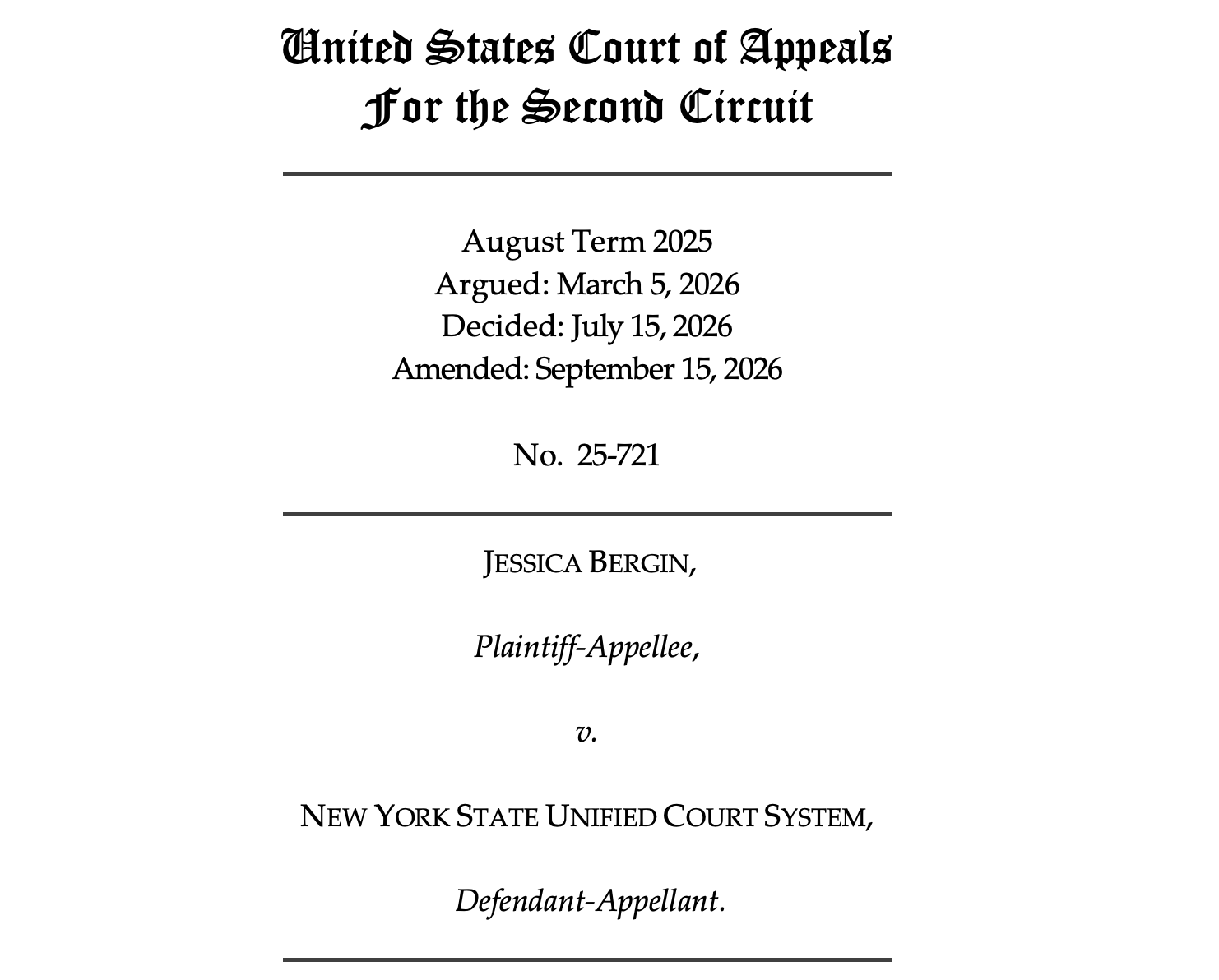
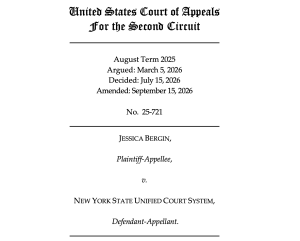
The Second Circuit has just rewritten the rulebook for religious accommodation claims under Title VII, a change that matters for employers and employees in the Court’s jurisdiction, including in New York, Connecticut, and Vermont. In Bergin v. New York State Unified Court System, decided in September 2026, the Court of Appeals held that a Supreme Court decision from a decade ago, EEOC v. Abercrombie & Fitch Stores, Inc., had quietly abrogated the Second Circuit’s longstanding three-part test for stating a prima facie case of failure to accommodate religion. That holding, found in Part A of the court’s decision, is the focus of this post.
The Facts: A COVID-19 Vaccine Exemption Dispute
Jessica Bergin worked as a court officer for the New York State Unified Court System (UCS) starting in 2016. When UCS rolled out a COVID-19 vaccination mandate in September 2021, Bergin sought a religious exemption, submitting a personal statement, scripture citations, and a letter from her pastor objecting to the use of fetal stem cell lines in vaccine development. UCS’s vaccine exemption committee asked her to complete a supplemental form probing the consistency of her beliefs; Bergin’s initial response left most questions unanswered. UCS denied her exemption, she did not get vaccinated by the deadline, and she was ultimately terminated in April 2022. (UCS rescinded the mandate in 2023 and reinstated Bergin shortly after.)
Bergin sued under Title VII, claiming UCS failed to accommodate her religious beliefs. The district court granted her partial summary judgment, finding she had established a prima facie case of religious discrimination and that UCS hadn’t proven undue hardship. UCS appealed.
The Old Test And Why the Second Circuit Says It’s Gone
For decades, the Second Circuit required a plaintiff alleging failure to accommodate religion to show three things: (1) a bona fide religious belief conflicting with a job requirement, (2) notice of that belief to the employer, and (3) discipline for failing to comply with the requirement. This framework traced back to Philbrook v. Ansonia Board of Education (1985) and was repeated in later cases like Knight and Baker.
UCS argued on appeal that this test could no longer stand because the Supreme Court’s 2015 decision in EEOC v. Abercrombie & Fitch changed the analysis. In Abercrombie, the Supreme Court held that a job applicant did not need to have explicitly requested a religious accommodation to bring a viable Title VII claim; instead, what mattered was whether the employer’s desire to avoid accommodating a religious practice was a motivating factor in its decision, regardless of how much the employer actually knew.
The Second Circuit agreed with UCS. Judge Nathan’s opinion explained that the old Second Circuit test’s notice requirement, and its lack of any explicit motive element, could not be reconciled with Abercrombie‘s core holding that Title VII “prohibits certain motives, regardless of the state of the actor’s knowledge.” Because an intervening Supreme Court decision can override circuit precedent when it “breaks the link” on which that precedent depended, the panel held that Philbrook and its progeny are no longer good law.
The New Prima Facie Standard
Going forward, to state a prima facie case of failure to accommodate religion under Title VII in the Second Circuit, a plaintiff must show:
- That she actually required an accommodation of her religious practice;
- That the employer’s desire to avoid providing that accommodation was a motivating factor in
- An adverse employment decision.
Notably, the court rejected several of Bergin’s arguments for avoiding this result. It found no support for treating recent Second Circuit language discussing the old test as binding, since those references were dicta rather than considered holdings. And it rejected the argument that Abercrombie applies only to failure-to-hire cases, holding that Title VII’s text draws no distinction between hiring and firing decisions; rather, the same motive-based standard governs both.
The court did clarify one important limit: this is not a heightened “discriminatory animus” requirement. An employee still doesn’t need to prove the employer harbored hostility toward religion generally. But the employee must now show that the employer’s decision was motivated by a desire to avoid the accommodation itself, not merely that the employer knew about the religious request and denied it.
Why The Bergin Decision Matters
This decision meaningfully raises the bar and reshapes the analysis for religious accommodation claims litigated in the Second Circuit. Employers defending these claims now have a clearer, motive-focused framework to argue toward at summary judgment. Employees and their counsel, meanwhile, may consider developing evidence that speak directly to the employer’s motivation in denying an accommodation, not just to notice and discipline. Because the district court in Bergin never applied this standard, the case is headed back for further proceedings. How the case is decided on remand may offer an early roadmap for how this new test operates in practice.
Employers navigating religious accommodation requests, and employees who believe their requests were wrongly denied, should consult with experienced employment counsel to understand how this shift affects their rights and obligations. The employment lawyers at Famighetti & Weinick PLLC are available at (631) 352-0050 or at http://linycemployment.com.
The full decision is available on the Second Circuit’s website: https://ww3.ca2.uscourts.gov/decisions/OPN/25-721_amd_opn.pdf.
This post is for informational purposes only and does not constitute legal advice. If you have questions about a religious accommodation issue in the workplace, contact Famighetti & Weinick PLLC.