- Free Consultation: (631) 352-0050 Tap Here to Call Us









Second Circuit Raises the Bar — and Realigns It — for Religious Accommodation Claims Under Title VII


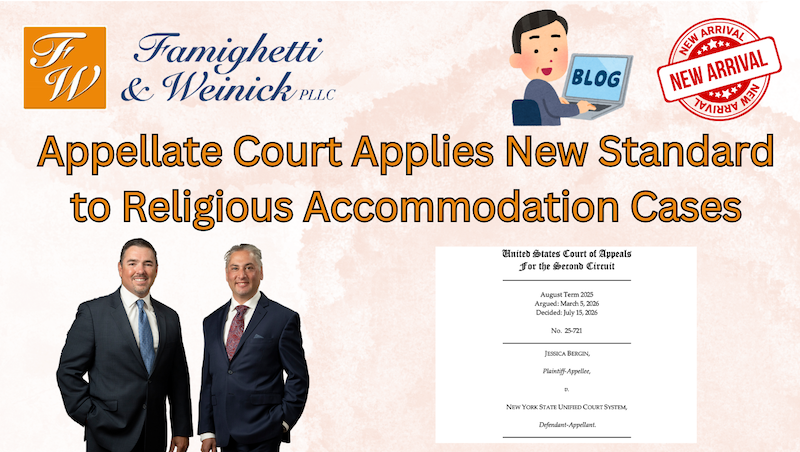
On July 15, 2026, the U.S. Court of Appeals for the Second Circuit issued an important decision in Bergin v. New York State Unified Court System, No. 25-721, that changes how employees in New York, Connecticut, and Vermont must prove failure-to-accommodate religion claims under Title VII of the Civil Rights Act of 1964. For employees who believe their employer refused to accommodate a sincerely held religious belief, this ruling raises the evidentiary bar — but it also clarifies exactly what employers can and cannot get away with during the accommodation process.
The Background
Jessica Bergin, a New York court officer, requested a religious exemption from her employer’s COVID-19 vaccination mandate. When the Unified Court System’s vaccine exemption committee asked her to complete a supplemental questionnaire probing the basis for her beliefs, she returned it largely unanswered, citing a desire to keep her medical information private. Her exemption was denied, and she was ultimately terminated for refusing vaccination. She sued, arguing UCS failed to accommodate her religion.
The district court sided with Bergin at summary judgment, relying heavily on statements a UCS administrator made during discovery that her initial exemption request was “perfectly adequate” and had explained a religious belief. The district court treated those statements as binding judicial admissions and found UCS could not show that accommodating Bergin would have caused undue hardship. UCS appealed.
The Second Circuit’s Holding: A New Prima Facie Standard
For decades, employees in the Second Circuit’s jurisdiction only had to show three things to get a failure-to-accommodate claim off the ground: a bona fide religious belief conflicting with a work rule, notice to the employer of that belief, and discipline for noncompliance. That framework came from Philbrook v. Ansonia Board of Education and was reaffirmed in cases like Knight v. Connecticut Department of Public Health.
The Second Circuit has now held that this long-standing test did not survive the Supreme Court’s 2015 decision in EEOC v. Abercrombie & Fitch Stores, Inc. In Abercrombie, the Supreme Court ruled that a job applicant need not have explicitly requested a religious accommodation in order to prevail — what matters is whether the employer’s desire to avoid providing an accommodation motivated its decision, regardless of what the employer actually knew.
Applying that reasoning, the Second Circuit adopted a revised, three-part prima facie test for failure-to-accommodate-religion claims:
- The employee actually required an accommodation of her religious practice;
- The employer’s desire to avoid providing that accommodation was a motivating factor in
- An adverse employment action.
Notably, the court rejected Bergin’s argument that this framework should be limited to hiring decisions (the context in Abercrombie itself). The court found nothing in the statutory text distinguishing hiring from firing, and it declined to read a special carve-out into Title VII for termination cases.
Why This Matters: Motive, Not Just Knowledge
The practical effect is significant. Under the old rule, an employee who simply notified her employer of a religious conflict and was later disciplined had cleared the first hurdle. Under the new standard, an employee must show that the employer’s desire to avoid accommodating her — not merely its awareness of her beliefs — factored into the adverse decision. Knowledge of a religious conflict remains relevant evidence of motive, but it is no longer, by itself, enough to get a case to a jury or survive summary judgment.
The Judicial Admission Issue
The court also addressed how much weight can be given to statements employers make during litigation. The district court had treated UCS’s discovery admission — that Bergin’s initial exemption request was “adequate” and “explained a religious belief” — as a conclusive judicial admission establishing that Bergin held a sincere religious objection. The Second Circuit disagreed, holding that those statements, read in context alongside UCS’s insistence that it needed more information to assess sincerity, were not sufficiently clear and unambiguous to qualify as binding admissions. This is a useful reminder for both plaintiffs and employers: courts will scrutinize discovery statements in their full context rather than isolating favorable soundbites.
What This Means for Employees and Employers
For employees pursuing religious accommodation claims, this decision means building a stronger record connecting an employer’s actions to a discriminatory motive — not just documenting that a request was made and denied. For employers, the decision offers some breathing room in how their internal communications and discovery responses will be interpreted, but it does not diminish the underlying obligation to accommodate sincerely held religious beliefs absent undue hardship.
At Famighetti & Weinick PLLC, we help employees navigate exactly these kinds of shifting legal standards. If you believe your employer failed to accommodate your religious beliefs or practices, or if you have questions about how this ruling might affect a pending or potential claim, contact our office to discuss your rights. Visit our website at http://linycemploymentlaw.com or call as at (631) 352-0050.
This blog post is for informational purposes only and does not constitute legal advice.