- Free Consultation: (631) 352-0050 Tap Here to Call Us










New York Appellate Court: Waiting Outside a Locked Workplace May Be Paid Time


By Famighetti & Weinick PLLC | October 14, 2026
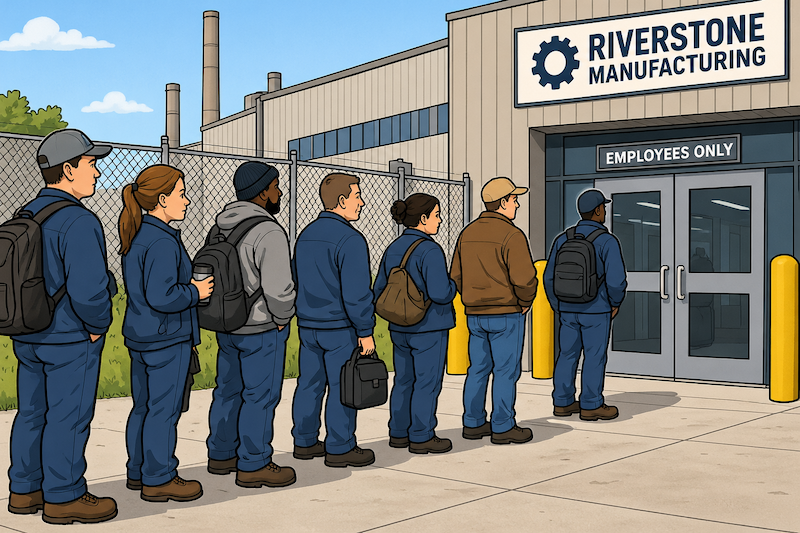
Most workers have shown up to a locked door at some point. But what if your employer told you to arrive early, you did, and you were left standing outside, unpaid, because no manager had come to open up? On October 13, 2026, the Second Circuit Court of Appeals in New York addressed that question in Santos v. Lidl US, LLC, and its answer is a meaningful win for hourly employees in New York, Connecticut, and Vermont.
What Happened
Sandra Santos worked as a store clerk and stocker at Lidl grocery stores in West Babylon, New York. She was scheduled for a 5:00 a.m. opening shift at $16.50 per hour. According to her complaint, Lidl required her to report fifteen minutes early, at 4:45 a.m., but she could not clock in until she got inside the store, where the time clock was located.
Opening managers allegedly did not always arrive on time. Roughly once a week, Santos and her coworkers were left waiting for a manager to let them in, and they went unpaid for that time. Santos sued on behalf of herself and similarly situated employees under the Fair Labor Standards Act (FLSA) and the New York Labor Law (NYLL).
The district court dismissed the claims. It held that the Portal-to-Portal Act, a 1947 federal law, barred the claims. That Act generally says employers need not pay for “preliminary” or “postliminary” activities, meaning things that happen before or after the principal work of the job begins.
The Second Circuit’s Ruling
The Second Circuit vacated the dismissal. Writing for the majority, Judge Robinson explained that the Portal-to-Portal Act does not end the analysis. A Department of Labor regulation, 29 C.F.R. § 790.7(h), draws a key distinction between an employee who is engaged to wait and one who waits to be engaged.
When an employer requires an employee to report at a particular time, the employee arrives ready and willing to work, and there is no work available for reasons beyond the employee’s control, the waiting is part of the job and must be paid. The court noted that the Supreme Court has long recognized that an employer can hire a worker’s readiness to work, not just the work itself.
The court also rejected two of Lidl’s arguments. First, it declined to read the Supreme Court’s decision in Integrity Staffing Solutions v. Busk as wiping out the “engaged to wait” rule. Second, it refused to limit that rule to traditional on-call workers such as firefighters. Nothing in the regulation’s text, the court said, excludes grocery store employees.
Because the case was dismissed at the earliest stage, the court accepted Santos’s allegations as true, that Lidl required the early arrival, and the delays were beyond her control.
Is Fifteen Minutes a Week “De Minimis”?
Lidl argued in the alternative that the claim involved such small amounts of time that it was legally trivial. The Second Circuit declined to affirm on that basis. Courts in the Second Circuit weigh the administrative difficulty of recording the time, the size of the claim in the aggregate, and whether the time recurs regularly. On the complaint alone, the court could not say that fifteen unpaid minutes a week, repeated across many employees and many weeks, was de minimis as a matter of law. It also found no basis to conclude that tracking the time would be too burdensome.
The Dissent
Judge Sullivan dissented. In his view, Santos’s wait was a routine preliminary activity that occurred before her shift began, and she could have simply arrived at 5:00 a.m. He also argued that the “engaged to wait” regulation is best suited to on-call workers. The disagreement suggests Lidl may seek further review, and employers will likely test the limits of this decision.
What This Means for Employees
This ruling is not a final victory for Ms. Santos. The case returns to the district court, where she must still prove her allegations. But the decision is important because it keeps the door open for employees in a very common situation. If you are required to arrive at a set time, you show up ready to work, and you are stuck waiting because of something outside your control, such as a late manager, a locked building, or a system that is down, the employer may be required to pay for that time. It may also count toward overtime.
It is worth keeping simple records such as the required arrival time, when the employee actually arrived, when work began, and who told the employee to be there. Texts and emails instructing the employee to arrive early can be especially valuable.
What This Means for Employers
Employers should review opening procedures, especially where time clocks are inside a locked facility. Requiring early arrival while making clock-in impossible is a risk. Practical fixes include moving or adding time clocks, using mobile or remote clock-in, ensuring keyholders are reliable, or clarifying that employees need not arrive before the paid start time. Because these claims are often brought as collective and class actions, small daily gaps can add up quickly.
Talk to an Employment Lawyer
Unpaid waiting time, off-the-clock work, and time shaving are among the most common wage violations we see. If you believe you have not been paid for all the time you were required to be at work, the attorneys at Famighetti & Weinick PLLC can review your situation and explain your options. Our wage and overtime lawyers are available at (631) 352-0050 or on the web at http://linycemploymentlaw.com. The full Second Circuit decision is available on the court’s website.
This post is for general informational purposes only and is not legal advice. Reading it does not create an attorney-client relationship. Consult an attorney about your specific circumstances.