- Free Consultation: (631) 352-0050 Tap Here to Call Us









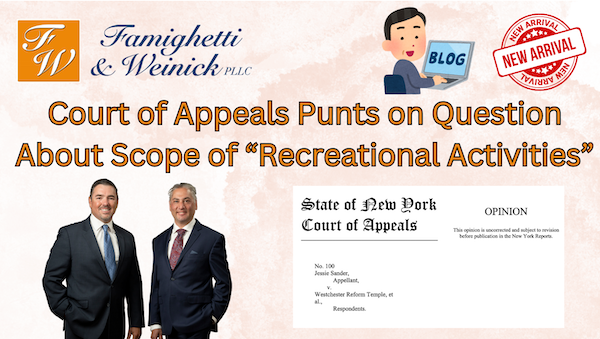
New York Court of Appeals Punts on Question of Whether 201-d Protects Social Media Posts and Blogging


New York Labor Law Section 201-d provides some workplace protections for employees who engage in, among other things, lawful recreational off-duty activities. This broad protection is somewhat ill-defined. The law, passed before the proliferation of social media and other electronic communications, could not have considered whether these modern day internet activities fall under the statute’s coverage.
At Famighetti & Weinick PLLC, we have used 201-d in some social media contexts. Employees who have been targeted for “cancellation” based on provocative social media posts, leading to trouble at work, have called us for help. We have had occasion to argue to employers that 201-d protects the employees’ social media activity, but we have not had occasion to test the theory in court.
Another case, however, reached New York’s highest court which issued a decision. But, the decision punts on what is in our opinion the more interesting question of whether 201-d protects social media posts. Instead, the Court relied on the ministerial exception to rule that the employee’s conduct is not protected by the statute. What is the ministerial exception and how does it relate to Labor Law 201-d? Today’s employment law blog discusses.
Background: Blogging, Labor Law § 201-d, and Employment Termination
Jessie Sander was employed as a “Full Time Jewish Educator” at Westchester Reform Temple, a religious institution. Shortly after beginning her hire, she co-authored a blog post critical of Israel and Zionism — content unrelated to her official duties. Although she assured supervisory clergy that her personal views would not be shared in her workplace role, she was terminated less than a week after the conversation. Sander then sued the Temple, asserting that her dismissal violated New York Labor Law § 201-d(2)(c), which prohibits adverse employment actions against employees based on legal recreational activities conducted off-duty.
Under Section 201-d, employers may not punish employees for engaging in protected off-work activities, including legal recreational activities undertaken outside work hours. The statute defines “recreational activities” expansively to include lawful, leisure-time activities typically engaged in for enjoyment or relaxation.
Procedural History and Court of Appeals Review
In lower courts, the Supreme Court (trial level) and the Appellate Division agreed that Sander’s claim failed because the complaint alleged termination based on the content of her speech, not on the act of blogging—a legal recreational activity. The parties disputed whether blogging could even qualify as a protected recreational activity. The Appellate Division did not reach other defenses raised by the Temple.
On appeal to the New York Court of Appeals, the central questions were:
- Does Labor Law § 201-d protect the act of blogging or blogging’s content when such content is unrelated to work?
- Even if protected, are there legal defenses or exceptions that preclude an employment-related claim?
The Court accepted the appeal to address these issues, which touch on statutory interpretation and constitutional protections.
The Court’s Holding: Ministerial Exception Precludes the Claim
Rather than resolving whether blogging is a “recreational activity” under § 201-d, the Court affirmed the dismissal of Sander’s claim on constitutional grounds: the ministerial exception. Under this well-established doctrine, drawn from U.S. Supreme Court precedent (e.g., Hosanna-Tabor Evangelical Lutheran Church and School v. EEOC and Our Lady of Guadalupe School v. Morrissey-Berru), anti-discrimination or employment laws generally do not apply to employment decisions involving “ministers” of a religious institution. This is rooted in the First Amendment’s protection of religious autonomy and the institutional right to select its own spiritual leaders.
Although Sander’s role might not have been titled “minister,” the Court concluded — as a matter of law — that her actual duties were religious in nature. Her job description, reflected in the offer letter and official documents, emphasized teaching religious programs, supporting religious activities such as Shabbat and confirmation programs, and fostering religious identity. These core functions aligned with guiding religious education rather than secular instruction. As a result, the Court held that the ministerial exception categorically barred her claim, regardless of how § 201-d might otherwise apply.
The Court explicitly reserved the question of whether blogging constitutes recreational activity under § 201-d for another case, making clear that this statutory question did not need resolution given the overriding constitutional defense.
Key Legal Lessons and Practical Implications
The Sander decision carries several important takeaways for lawyers, human resources professionals, and employers with religious affiliations:
1. Ministerial Exception Applies Broadly to Religious Workers
The Court reaffirmed that the ministerial exception reaches beyond traditional clergy titles. Even if an employee’s title is non-ministerial, their core job functions and responsibilities determine whether the exception applies. Here, the job’s emphasis on religious education and mission justified excluding statutory employment protections from application.
2. Statutory Protections for Off-Duty Conduct Have Limits
Labor Law § 201-d aims to protect employees’ lawful off-duty activities from employer retaliation. Yet this protection is not absolute. The Court’s decision shows that when constitutional protections — like the free exercise of religion — conflict with statutory claims, constitutional doctrine can preclude statutory recovery. Moreover, the decision leaves open future clarification of what constitutes protected “recreational activity,” especially with modern online conduct.
3. Documentation Is Critical in Defining Job Functions
Here, the offer letter was pivotal in establishing that Sander’s duties involved religious functions. For employers, clear job descriptions and documented expectations can be crucial when defending against statutory claims. For employees, understanding how job documents align with actual responsibilities can shape employment rights and remedies.
Moving Forward: Areas for Further Development
While Sander resolves one important constitutional question, it leaves several unresolved issues ripe for future litigation:
- Statutory Scope of § 201-d: Does blogging—particularly expressive online activity—qualify as a “recreational activity” protected under state law? The Court deferred this question, inviting future cases to tackle it.
- Recreational vs. Expressive Activities: As digital platforms and expressive conduct blur traditional categories of recreation, courts will need to refine this area of law.
Conclusion: The Court of Appeals’ decision in Sander v. Westchester Reform Temple reinforces the enduring strength of the ministerial exception when constitutional values intersect with statutory employment protections. For legal practitioners advising clients in employment or religious institutional contexts, this case underscores the necessity of a nuanced understanding of both statutory rights and constitutional limitations.
If you have questions about 201-d, lawful recreational activities, or the ministerial exception, contact one of our employment law attorneys. Famighetti & Weinick PLLC can be reached at (631) 352-0050 or in the Hudson Valley at (845) 669-0040.
The full Sander decision is available here. Our prior blogs about the ministerial exception and 201-d are also available by following by the links.